Profiled sheet vs. metal tile — which suits your roof?
If you're new to the project, you're probably wondering what the difference is. It's simple: the tile is for pitched roofs and a residential look; profiled sheet is for halls, façades and roofs with a slight slope.
Technical basis: the Europrofill public catalogue and current production rules.
Compare all profiles- Stage
- Choose
- Topic
- Comparison
- Reading
- 1 min
- Updated
In detail
It's a common confusion—and it's natural. Both are 'tin', both come in RAL colours, both are mounted on a metal structure.
The difference is in the shape of the profile and its purpose.
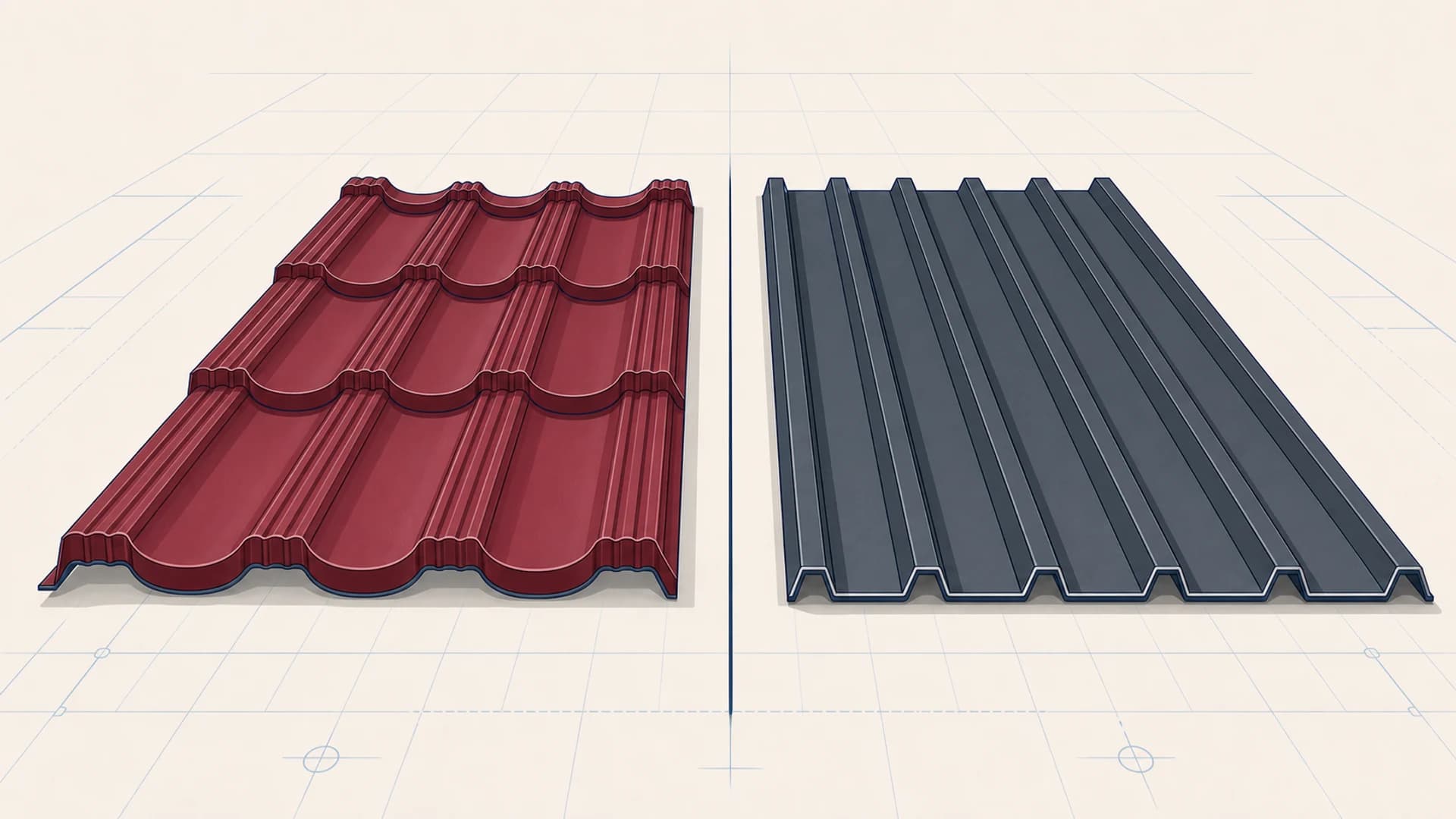
Metal tile—Bavaria, Monterey, Bango—has wavy, transverse ribs that look like ceramic tile. It is intended for pitched roofs (minimum 14°) and houses with a residential look. The profile wave, 18.4–32 mm high depending on the model, adds stiffness and sheds water efficiently.
Profiled sheet — H-7, H-8, H-10, H-20, H-35, H-55 — has longitudinal trapezoidal ribs from 7 to 54 mm high in the formed geometry. The minimum recommended pitch depends on the profile: in the catalogue the values range from 5° to 12°.
Orientation Rule: Metal tile is common on residential sloping roofs, and profiled sheet also serves halls, façades or smaller slopes. The final choice is checked by profile, structure, the opening between supports and the project.
The price is calculated from the complete specification available in the catalogue: profile, thickness, finish, colour and origin. Recalculate when you change any of these options.